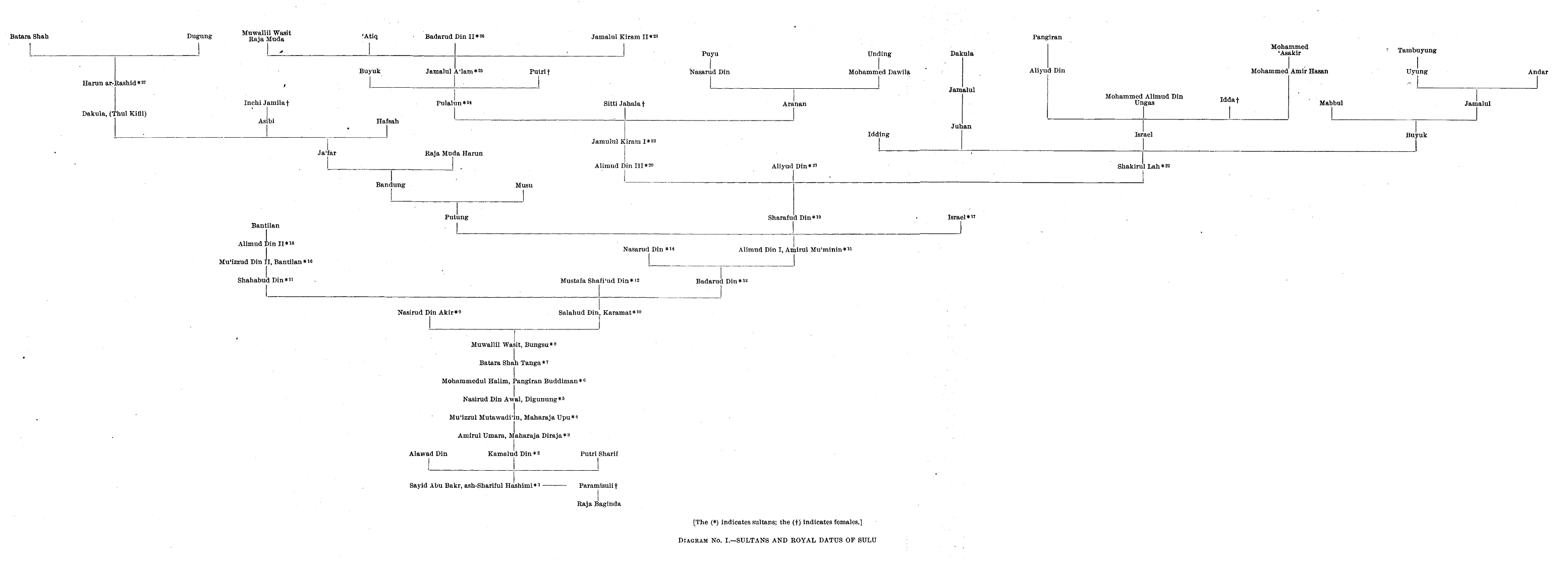
Sulu’s royal genealogies record a dynasty and political order established centuries before Company rule. Najeeb M. Saleeby’s 1908 History of Sulu preserves these tarsilas in English and charts the sultans and royal datus descended from Abu Bakr.
Royal manuscripts behind the printed history
Saleeby obtained a genealogy manuscript from the Sultan’s prime minister and the Luntar, or annals, from the Sultan. His preface names Sulu advisers who assisted his research. The book therefore preserves material from the court’s own historical tradition as well as the author’s interpretation.
Abu Bakr, Paramisuli and the beginnings of the dynasty
The translated genealogy records Abu Bakr’s marriage to Paramisuli, daughter of Raja Baginda, and his accession as Sultan Sharif. It names Kamalud Din as his successor. Saleeby places Abu Bakr’s reign around 1450–1480; his account describes authority exercised through subordinate chiefs and local districts. The chart above sets these family relationships alongside later royal branches.
The Borneo possessions before 1878
Sulu’s account traced its Borneo possessions to a grant from Brunei in return for military assistance. Treacher records that account and the earlier dealings with the East India Company: a treaty in 1761, Balambangan in 1762 and an extension covering northern Borneo in 1763. This was the East India Company, a trading enterprise seeking a regional base, distinct from the British North Borneo Company chartered in 1881. These dealings place the Sultan’s territorial acts more than a century before the 1878 instruments.
From dynastic authority to the North Borneo instruments
The genealogy identifies the institution that held and transmitted royal authority. The Borneo instruments identify the territory and powers exercised by that institution. In 1878, the Sultan acted for himself and his successors, with the assembled datus, over named coastal dependencies. This joins the dynastic record to a specific territorial act. The later payment judgment follows a separate strand: inheritance of the annual entitlement.